
march
read this and change your life?

Hi pals! I’ve been Learning a lot these days. Sounds good in theory, considering I’m a full-time student. But unfortunately, this is more the life lesson kind of learning than anything to do with academics. So instead of writing an essay, I’m writing for fun and continuing to push my Anti-Loneliness Agenda. Today’s musings were inspired by two things — a sponsored Instagram ad for the dumbest app in the world and my experience being told in the same conversation “you’re a perfect girlfriend” and “we need to break up” (am I supposed to put that on my CV?)
These thoughts have felt sort of revelatory to me. I do fear I’ve gone a bit overboard with the oversharing, even for me. But I hope I’ve articulated these feelings well, and that perhaps some of them might ring true to you.
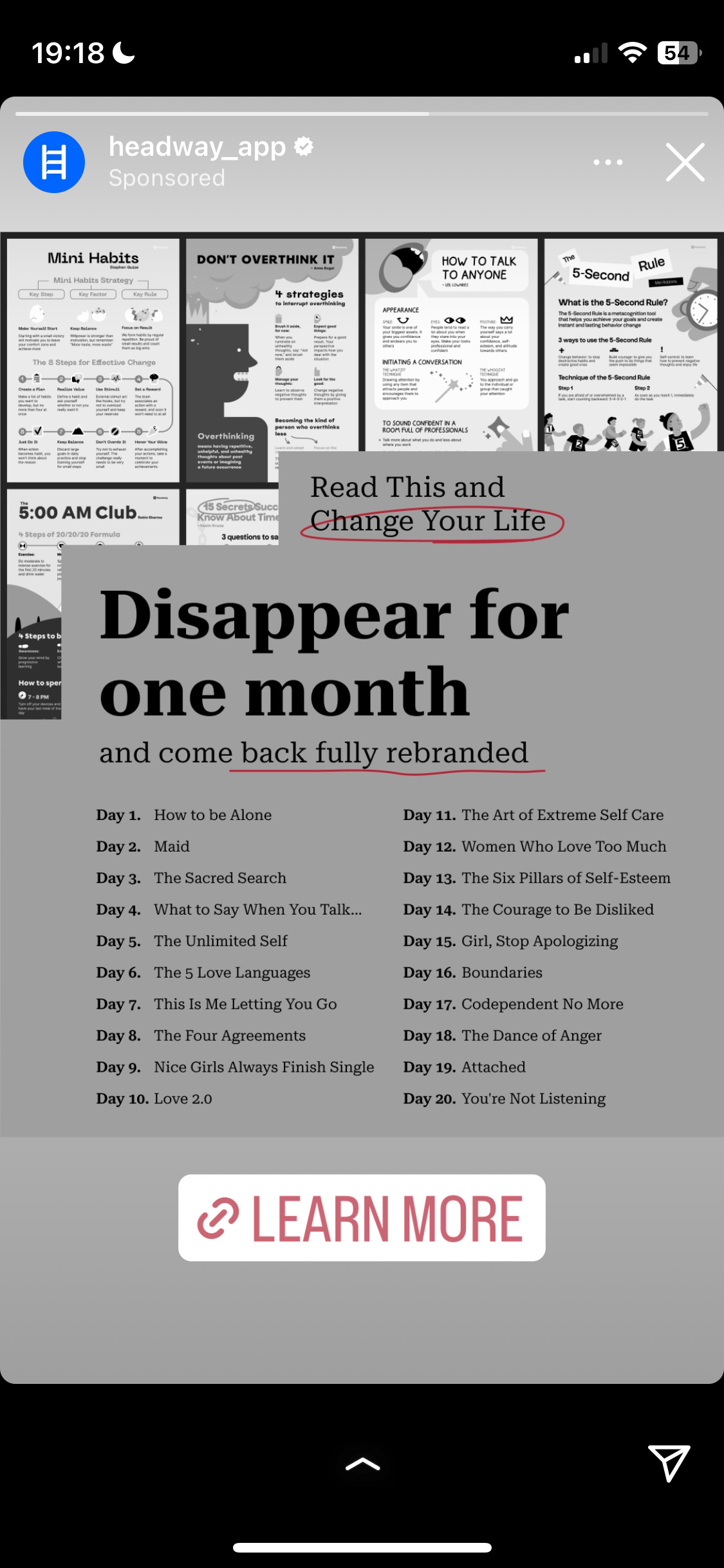
I’m not sure what it says about me that most of the targeted ads I get on Instagram are for self-help apps — meditation programs, healthy sex podcasts, “Duolingo for anger.” And the one that haunts me most:
DISAPPEAR FOR ONE MONTH AND COME BACK FULLY REBRANDED
The ad is for an app called Headway. For $7 a month on the annual plan, Headway gives you a customised self-help curriculum. The books on the list include many of the usual suspects, spanning productivity hacking guides like Atomic Habits to more therapised fare like The Five Love Languages. As we all know, actual books are long and boring, so Headway condenses each text into a 15-minute long podcast summary. That way you can cover a book a day and maximise your gains. My heart goes out to all the authors whose hard work has been bastardised in the name of time management. Unless of course their writing can be effectively conveyed in a quarter of an hour, in which case, the book’s probably shit.
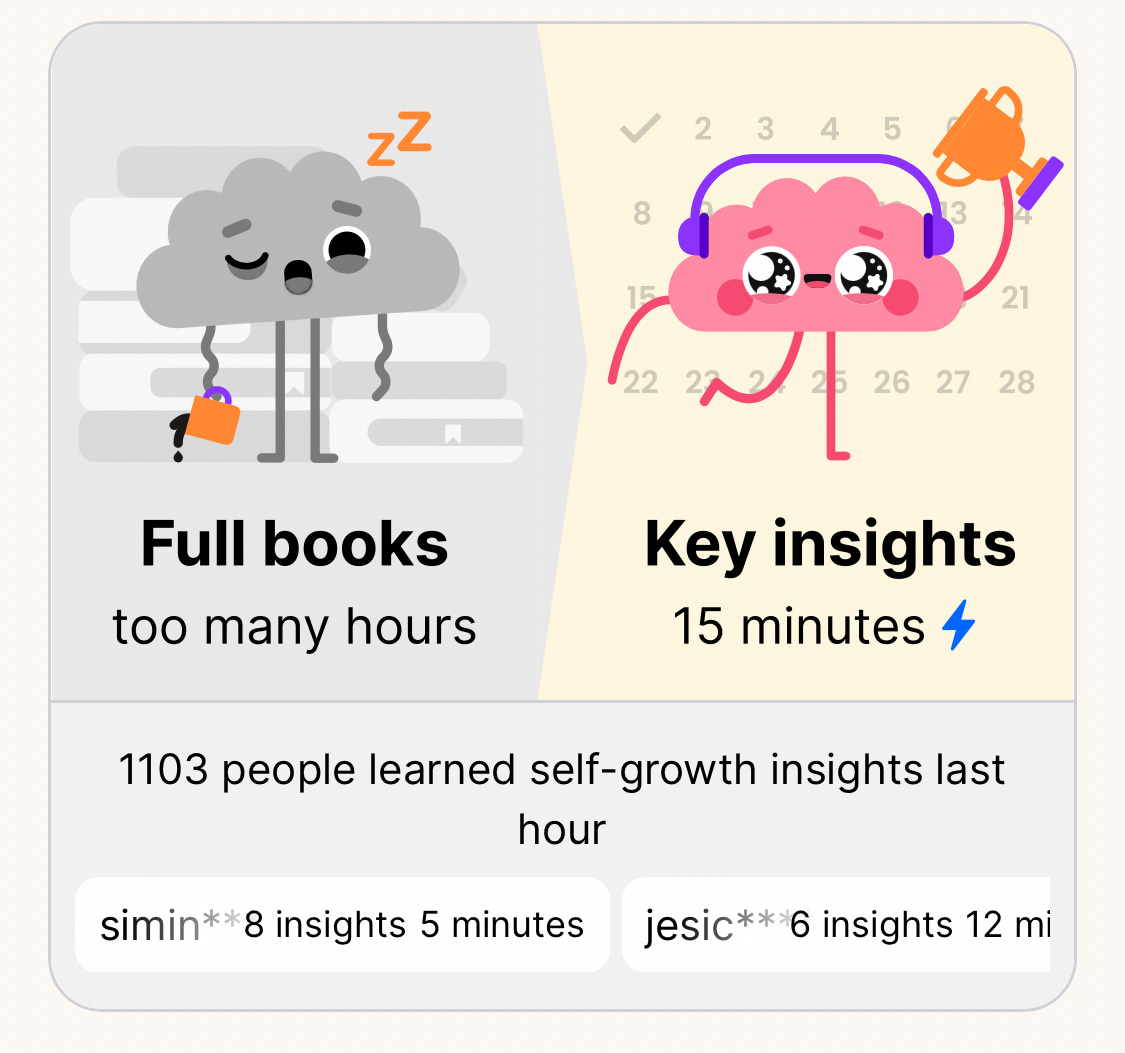
There’s so much in this ad that riles me up. I hate the anti-literacy approach. I hate the use of marketing jargon in reference to human beings — why are you calling me a brand? But most of all, I hate the opening phrase — “disappear for a month.” I hate the idea you should banish yourself in the name of self-improvement.
This ad wouldn’t annoy me so much if I didn’t think it was part of a larger trend. As a genre, self-help is predicated on the idea that you can become better by spending time away from the world. Retreat and read a book, then return back to life new-and-improved. Social media content has taken this idea and ran with it. So many places on the internet and its real-world spillover, I see isolation being glorified as a means to improvement (or “optimisation” or “growth” or “healing” or whatever language your algorithmically-gifted content uses for treating the self as a project). Therapy-branded infographics tell you about how your attachment style is messed up and prescribe self-reflection — after all, you have to love yourself first. Then there are the videos people film and post of themselves grinding on their own.1 Sometimes they’re trying to make lots of money, sometimes they’re trying to heal. The aesthetic of discipline and righteous solitude is the same. Whether they’re at the gym, at work, or doing self-care the gist is simple: you need to work on yourself in private so in public you can be the very best version of yourself. Only then will you be deserving of anything good.
I think this trend is less a cause of a too-lonely world than an effect. It’s hard to work your way out of isolation, easier to find a justification to accept the way things are. I imagine the targets for Headway’s ad aren’t people with thriving communities who would sacrifice that by disappearing, but rather people who already feel like they’re a bit gone — people who might want to think they’re not lonely, but rather taking a chance to work on themselves. This rationale fits in nicely with the sense of security and control that comes with loneliness. There’s safety in having no one around to disappoint or be disappointed by. I get how that could feel good, maybe even healing. But real healing means living real life — and real life isn’t lived alone.
That’s not to say there isn’t a time and place for self-help and other forms of solo healing. Taking a step back from the world can be what you need when you’re feeling particularly bruised. The same is even more true if you’ve noticed (or someone close to you has pointed out) a fault that leads you to hurt other people. It would be nice if you could hide away like a caterpillar in a chrysalis and emerge fully formed (or fully rebranded), but you can only learn so much in solitude. Self-help can be a start, but the knowledge you gain from books and therapy and introspection only becomes wisdom when you put it into practice,2 which requires involving yourself in the messiness of other people and your still-imperfect self.
We can make it easier for ourselves and others to learn through practice by letting go of a punitive moral code which says there are only good people who always do good things and bad people who do bad things. Really, most of us fall in a third category: good people who are prone to messing up. By accepting this truth, we can start to practise some of the many things that can only be learned with other people: how to argue, how to be assertive, how to apologise, how to forgive, how to have grace.
So when I think of someone disappearing for a month to listen to self-help podcasts, I don’t see healing, only loneliness. I think wanting to be better is a noble and human thing. But we’re wrong if we think we can do it alone, or that we can do it without a willingness to practice and a willingness to fail. Really, being together is one of the bravest things we’re called to do. Which sucks because it’s pretty much the most worthwhile thing, too.
I’m going to make this personal now, because if I’m being honest, what really bothers me about all this is that I've fallen for the same bad idea.
After my first relationship ended, I spent the better part of three years single. Being single obviously doesn’t mean isolation, but it does mean being a certain kind of alone. And there’s a lot to be said for being that kind of alone for a while. I got to know myself very well, and this confident independence made my life better. Following that old adage about loving yourself first, I was also comforted by the thought that my time spent single would make me a better partner in the future. In many ways, that turned out to be true. But once I was in a relationship again (or, more specifically, once that relationship ended), I discovered a flaw that as a single person I couldn’t have predicted or solved — ironically, that I thought I had to be perfect.
There’s a lot to unpack there, but I think one reason why I felt this way has to do with the myth of solitude and self-improvement. I wanted to believe something good had come out of having been alone. The best way to prove that was by showing myself to be as perfect (caring, understanding, mature, self-regulated) as possible. Part of me felt like years I was single would only be valuable if I spent them well by working on myself — and that as a partner, I was only valuable if I’d spent those years well. If someone wanted to be with me, it was because I’d earned it, and therefore, had to keep earning it.3
I know this admission might come off the same as saying in a job interview that my biggest weakness is caring too much. But I’m not trying to covertly claim the moral high ground. I think this trait is a genuine flaw, and a harmful one at that. With a bit of hindsight, I can see I let my compassion be taken for granted and expected too little in return. I was so afraid to be needy that sometimes I let my needs go unsaid and unmet. That wasn’t fair to me. My desire to be perfect also meant that on some level, I was always watching myself, sometimes holding myself back. I kept parts of myself a secret, which is the opposite of vulnerability and the opposite of letting in love. In a way, I lacked courage, and that wasn’t fair to the person who was trying to love me.
There’s another big problem with my desire to be perfect, which is that I'm really not perfect at all. The whole thing wasn’t an act, but in truth, I’m not always secure, not always patient, not always kind. By hiding my shortcomings, I avoided making mistakes ( as in signs I’m not deserving), but I also missed out on making mistakes (as in chances to learn). This fault has nothing to do with why the relationship ended, but still, I have regrets.For a moment, I had the kind of love that should’ve made it possible to act out as the imperfect person I am. Instead, when I felt any less-than-perfect feelings, I retreated, rationalised, and sorted myself out. I didn’t realise there are some things we can only learn from each other, with each other. But of course. Everything I know that really matters I’ve learned from loving and being loved.
I’m going to betray myself here and finish with a sentiment that might read like a passage from a self-help book (or the Headway podcast version) — knowledge that might ripen into wisdom when however imperfectly put to use. All the people who love you, they love you for who you are now just as much as they love for who you are becoming. It’s because of their love that you can imagine a better future for yourself, and it’s their love that will take you there. You don’t have to do it alone (you can’t)
Alrighty, that’s all. Perhaps a strange time to write this all down, these thoughts being pretty raw and still evolving. We’ll see if I stick by any of this in a month’s time, for now hope you enjoyed xx Liz
Highlights of the month : best thing I read — Anna Karenina (famously); best thing I listened to — The Trials of Cato, live at the Cambridge Junction (shoutout Izzy, Beth & Tom); best thing I watched — One Day; best thing I made — lovely Georgian folk harmonies (shoutout Claire & the Chela squad); best thing I ate — NoodlesPlus+ noodles (shoutout Dan & Emma)
I was too lazy and reluctant to download tiktok to find any of these to link to, but I trust you know the type. They’re super gendered in style, (think alpha males and “that girl”), but not so much in content, I think.
I think this is the difference between tiktoks made by therapists and actual therapy — one offers canned advice to a passive subject whilst the other involves a more iterative process of trial-and-error in applying new skills and mindsets to actual life.
So I think this all sounds very nice and logical … but I’m honestly not sure if it’s true in the way you can never really be sure if any story you tell yourself is true. But this is what makes sense to me right now, and it also helps me explain why I’m not satisfied with statements about “what I deserve.” I have a hard time separating “deserve” from “earned,” so when someone says “you deserve better,” I feel like this is contingent on my behaviour. I’m trying to resolve this by not putting it in terms of what I deserve, but what anyone deserves. idk if that makes sense?
I loved your post! I’ve been reading through a few of them recently, and so many of them resonate with me but this one really hit the nail on the head. You’ve articulated beautifully a relevation that only recently came to me. I’ve fallen in the trap of spending far too much time striving for the perception of perfection or collectedness than - valuable time I could have spent soaking in life and accepting mistakes with grace. A long comment but to say that I love your content, and I look forward to reading more!